Life after stopping Suboxone is different. A new crossing. The first month is different- especially. Your outcome is uncertain-a new adventure. It is not more of the same.
Addiction medicine provides guidance. The richness of the science is fun to read; how and if you use it is your choice.
I will outline for you the classic study of Weiss, as well as the significant studies of Sordo, Boxinoff, and Gantz.
With the discontinuation of buprenorphine:
- Return to opioid use is common- Roger Weiss
- Risk of death increases-Sordo
- Buprenorphine treatment is often begun again- Boxinoff
- No time on treatment predictably reduces risk of stopping treatment-Gantz
Your Life! Your Choice! Your Recovery!
How will you use the guidance of science?
The Author
William Conway, MD, FACP, FASAM
Independent Physician: General Internal Medicine and Addiction Medicine
Writer Exploring Life’s Lessons from Autobiographies of Persons using Heroin
Fellow, American College of Physicians (Internal Medicine)
Fellow, American Society of Addiction Medicine
Member, American Academy of Addiction Psychiatry
Current Areas of Interest
- Diabetes
- Women’s Health
- Aging and Longevity
Tennessee License: MD35708
Maintenance of Certification in Addiction Medicine, American Board of Preventive Medicine
Education:
- The Ohio State University
- Capital University Graduate School of Administration
- AB with Honors, University of North Carolina at Chapel Hill
- Department Honors in Religious Studies
- Capstone paper Existentialism
- Phi Beta Kappa as a junior
- Nominated for Danforth Fellowship in Humanities
- Western Reserve Academy
Return to Opioid Use is common After Stopping Suboxone
I had a class at Harvard with Roger Weiss. His “ Prescription Opioid Addiction Treatment Study” is a foundational study guiding the practice of addiction medicine. His study is a model of rigorous scientific logic, executed across multiple sites, with NIH as the gold-standard sponsor. Roger Weiss is a scholar and a gentleman- a generational thinker.
Addiction is like both politics and religion. I will never forget a Sunday service in Savannah, Tennessee, with the minister admonishing, “Those people who go to a local NA meeting.” Everyone has definite beliefs. The existence of God has been debated in Western philosophy for centuries. No Christian doubts the existence of God.
The fervor of dearly held beliefs about addiction has the intensity of the Reformation challenging Rome.
Is abstinence through 12-step the only valid route to freedom? Is opioid use disorder a disease which is best treated pharmacologically? Is a physician in an office- without the formal structure of a methadone clinic- good enough? Are you still ‘dirty’ with suboxone? Are you substituting fentanyl with suboxone- still “dirty.’ How much counseling is enough? Was Dr. Marie Nyswanger right in her belief that successful treatment of opioid addiction is pharmacological?
The treatment of addictions has its denominations; each tribe with their beliefs-often intolerant of alternatives
Weiss does not address all the cultural issues of addiction. Weiss is a clinical scientist and professor of Psychiatry at Harvard Medical School. He addresses three foundational issues in the practice of addiction medicine
- What is the outcome with brief buprenorphine treatment?
- What is the outcome with short-term buprenorphine treatment?
- Does the absence of opioid counseling change the outcome of buprenorphine treatment?
Lessons from Roger Weiss
- Buprenorphine Treatment less than One Month had a 6.6% chance of being opioid free two months later
- Buprenorphine Treatment of three months had a 6% chance of being opioid free two months later
- Taper is associated with mild adverse effects, commonly headaches
- Taper is occasionally associated with severe psychiatric decompensation, including hospitalization
- The treatment group with counseling did no better than the treatment group without counseling
Deep Dive into Weiss et al. | Prescription Opioid Addiction Treatment Study
The Prescription Opioid Addiction Treatment Study (POATS) was a multi-site randomized NIH trial.[i] It enrolled more than 650 patients whose opioid dependence developed from prescriptions from physicians. This complicated study had two phases:
Brief Phase (phase1) included two weeks of buprenorphine-naloxone stabilization followed by a two-week taper and 8-week post-medication follow-up. Patients in this phase were randomized to Standard Medical Management or Standard Medical Management with Opioid Drug Counseling.
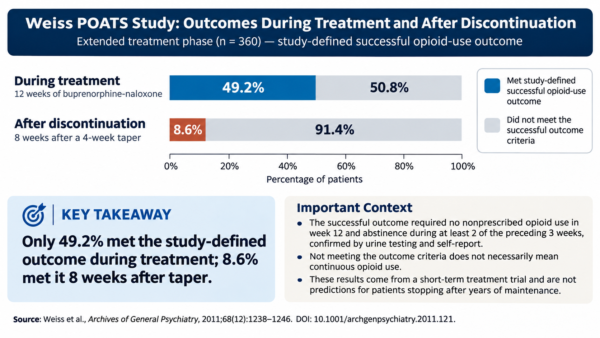
Extended Phase (phase 2) consisted of a 12-week buprenorphine-naloxone treatment, followed by a 4-week taper and an 8-week post-medication follow-up. This phase included patients who continued to use opioids or had a positive urine drug screen. Patients in this phase were randomized into standard medical management or standard medical management with opioid counseling.
Results were
- In Phase 1, only 6.6% had successful outcomes, with no differences between those randomized to Standard Medical Management versus Standard Medical Management with Opioid Drug Counseling
- In Phase 2, the extended phase of 12 weeks of buprenorphine-naloxone treatment, followed by a four-week taper, only 8.6% remained opioid free in an 8-week follow-up.[ii]
Exclusion criterion for this study
- Use of heroin >4 days in the past month
- Lifetime diagnosis of opioid dependence due to heroin alone
- Ever injected heroin
- Required ongoing pain management with opioids
- Experienced a major event in the past six months
- Were prescribed methadone > 40 mg/day for pain
- Psychotic, suicidal, or psychiatrically unstable
- Currently participating in formal substance abuse program- NA permitted
- Pregnant or lactating
- Medical detoxification from alcohol
Adverse Events in both phases
- In Phase 1, most patients experienced side effects, most commonly headaches, constipation, and insomnia.
- In Phase 2, most patients experienced side effects, most commonly headaches, nasopharyngitis, and nausea.
- 12 serious side effects, with psychiatric side effects most common serious side effects, particularly depression leading to hospitalization
Weiss conclusion was
‘Prescription opioid-dependent patients are most likely to reduce opioid use during buprenorphine-naloxone treatment. If taped off buprenorphine-naloxone treatment, even after 12 weeks of treatment, the likelihood of unsuccessful outcome is extremely high, even among patients receiving counseling’
Weiss, the superior scientist and clinician asks:
“What length of buprenorphine-naloxone treatment, if any, would lead to substantially better outcomes after taper?”
Limits to POATS
Understand the clear limits to POATS. It does not tell us what will happen if a patient discontinues suboxone after three, five, or ten years of stability. For the question that my patients ask after years of treatment, POATS does not give the answer
The Risk of Death is Highest in the First Month After Stopping Suboxone
Mechanism of Tolerance
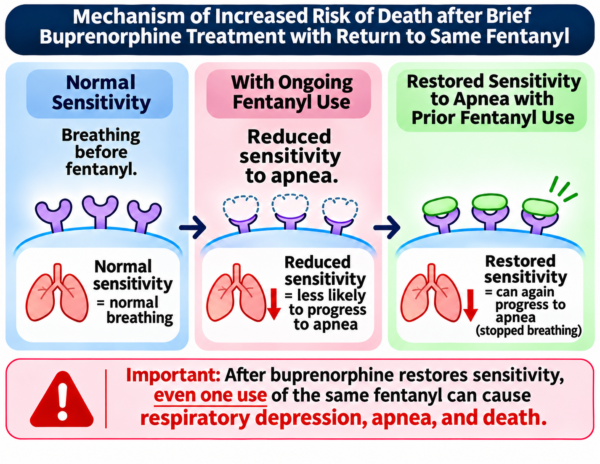
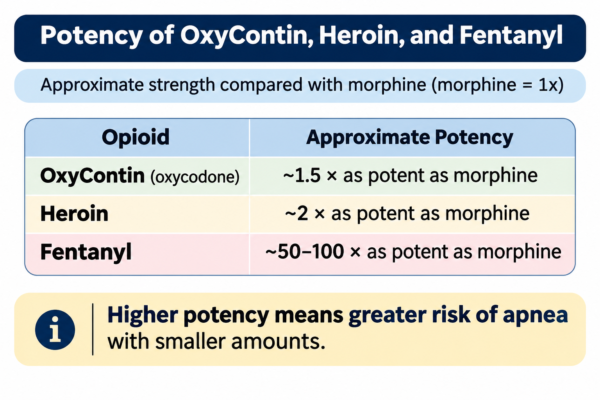
Buprenorphine changes your biology; Your tolerance to opioids is lessened with buprenorphine. Do you remember how, over time, you required more and more OxyContin, heroin, or fentanyl to reduce withdrawal? This is called tolerance. The brain’s receptors adapt to the frequent use of opioids by requiring more for the same effect. Buprenorphine reestablishes the brain’s sensitivity to opioids.
The commonsense understanding is the following. During your brief or limited buprenorphine treatment, you will respond differently if you begin the same amount of heroin, oxycontin, or fentanyl than before. Heroin, fentanyl, and OxyContin can stop the respiratory drive. Death occurs within a few minutes when breathing stops.
The Meaning of Potency
Mortality is Increased in the First Month after Discontinuance of Buprenorphine
Understanding Sordo
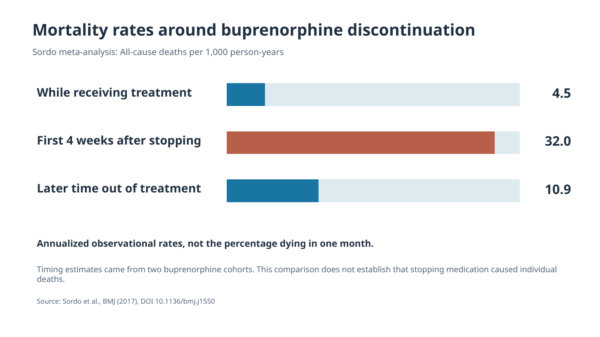
The risk of death is
- Lowest while on buprenorphine maintenance
- Highest in the first four weeks of stopping treatment
- Is higher in the long term out of treatment than while in treatment
Deep Dive: Sordo Systematic Review. Mortality During and After buprenorphine Treatment
Sordo’s systematic review and meta-analysis pooling data from more than 120,000 patients on opioid substitution treatment found that the all-cause mortality was approximately 2.2-fold higher during periods off treatment than during treatment.[iii] Overdose mortality followed the same pattern. The temporal analysis identified that the mortality risk is concentrated in the early weeks after cessation, not distributed evenly across the post-treatment period. In the two buprenorphine cohorts, the all-cause mortality was 32 per 1000 patient-years in the first four weeks after cessation, falling to 10.9 thereafter. The risk profile changes quickly after treatment ends.
Sordo’s study included analysis of methadone maintenance as well as buprenorphine maintenance. In Sordo, early post-cessation buprenorphine maintenance came from a small number of cohorts, with much of the time-stratified data from Australia. This more limited data support Soto’s conclusions. The available time -stratified data for buprenorphine suggests that mortality risk is particularly high in the first weeks after cessation
What Happens to Patients After Stopping Suboxone?
Take-Home Points from Boxinoff
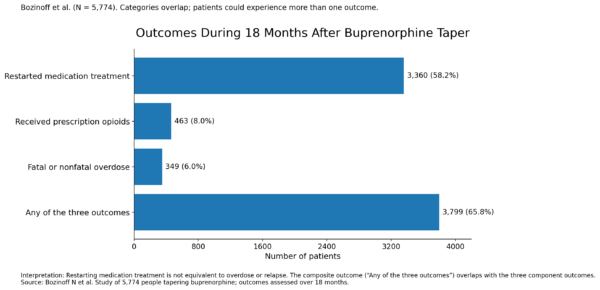
Boxinoff shows the observed outcomes in 600 patients who discontinued buprenorphine treatment
- 58% returned to treatment
- 6% had an overdose
- 8% began prescription opioids
- Approximately 34% did not return to treatment, overdose, or begin prescription opioids
A deep Dive into Boxinoff et al
Boxinoff et al. [iv] studied a population-based cohort of nearly 6000 patients who underwent a buprenorphine taper. Among the 5,774 people in a buprenorphine taper, about 66 % experienced at least one overdose, began treatment again with medication used for opioid use disorder, or began prescription opioid use. Nearly six in 10 patients returned to treatment. These paths occurred within 18 months of taper
Does Longer Suboxone Treatment Make Stopping Safer?
Take Home Points
Does the duration of treatment with buprenorphine matter? Treatment anniversaries are calendar events- not biological events. There is no evidence that validates any treatment duration as predictably safe.
Deep Dive on Gantz
Longer time on buprenorphine is associated with lower risk for some post-discontinuance outcomes. Gantz[v], et al did a multi-site cohort study of more than 6500 patients who discontinued buprenorphine across eight US health systems. They found that patients who discontinued buprenorphine after 91 days to 180 days had nearly a threefold higher opioid overdose hazard when compared with treatment over one year. However, the same study found no treatment duration associated with a statistically significant reduction in all-cause mortality. No duration period was identified at which risk was eliminated
Conclusion: Returning to the Corner of Fear and Hope
The four crossings with buprenorphine treatment are
- A brief crossing: Your choice is to use Suboxone briefly.
- A longer crossing: Your choice is to use Suboxone for a few years.
- Crossing back and forth: Your choice is to stop and return. You may repeat this choice several times in a lifetime
- A Lasting crossing: Your choice is to continue Suboxone for many years, sometimes for life.
The Corner of Hope and Fear is a place you may pass through many times. Some return to it repeatedly. Each time, the circumstances of the choice may differ.
The Corner of Hope and Fear is not a place a person passes through only once. Some return to it repeatedly, and each time the circumstances of the choice may be different.
[i] Weiss RD, Potter JS, Fiellin DA, et al. Adjunctive Counseling During Brief and Extended Buprenorphine-Naloxone Treatment for Prescription Opioid Dependence. Archives of General Psychiatry. 2011;68(12):1238–1246. doi:10.1001/archgenpsychiatry.2011.121.
[ii] Weiss RD, Potter JS, Fiellin DA, et al. Adjunctive Counseling During Brief and Extended Buprenorphine-Naloxone Treatment for Prescription Opioid Dependence. Archives of General Psychiatry. 2011;68(12):1238–1246. doi:10.1001/archgenpsychiatry.2011.121.
[iii] Sordo L, Barrio G, Bravo MJ, et al. Mortality risk during and after opioid substitution treatment: systematic review and meta-analysis of cohort studies. BMJ. 2017;357:j1550. doi:10.1136/bmj.j1550.
[iv] Bozinoff N, Men S, Kurdyak P, Selby P, Gomes T. Prescribing Characteristics Associated With Opioid Overdose Following Buprenorphine Taper. JAMA Network Open. 2022;5(9):e2234168. doi:10.1001/jamanetworkopen.2022.34168.
[v] [iii] Glanz JM, Binswanger IA, Clarke CL, et al. The association between buprenorphine treatment duration and mortality: a multi-site cohort study of people who discontinued treatment. Addiction. 2023;118(1):97–107. doi:10.1111/add.15998.