Where Care Becomes Quiet Understanding
I am William Conway, a concierge physician in Nashville. To us, “concierge” means that I know you, I’m available to you, and I keep your story private and safe. When you speak, I hear what you say and what you do not say. I understand both the conscious and the unconscious, the quiet meaning that is the essence of you. Understanding this quiet essence allows us to share space which is meaningful to us both. Our professional relationship means that I am your doctor, with all that entails.
Our relationship will be both professional and spiritual. I’m a person, not a system, and so are you. My promise, as a healthcare professional committed to helping people, is to be your point person each and every time we meet. When you make an appointment with me in my clinic, I will be the person to shake your hand and look you in the eye, and together we will make decisions that will help you in your journey towards health.
In my practices- Nashville Suboxone+Primary Care™ and Nashville Concierge Medicines- I study constantly so that your care is well-informed. And I write constantly, so that your care is understandable. In our shared space, we will meet together and discuss whatever matters most to you, and we will share your future with joy.
Case Study: Samantha
It’s not like she had just decided to drink so much. And it certainly didn’t happen all at once. Always a social drinker, Samantha kept up the weekend habit of having a few glasses of wine even when she wasn’t out with other people. When she lived alone in her mid-20s, this became an almost nightly habit: wine and pasta for dinner in front of the TV. When she met- and a year later, married- Dave, the evenings of wine with dinner continued, and felt even more comfortable and fun. She didn’t realize how her drinking had increased. So many bottles went into the recycling bin every week! But of course, there were two people drinking now, so why wouldn’t there be?
She took the required break from alcohol when she realized she was pregnant just a year into the marriage. Breastfeeding slowed her down some, but a few months after the baby was born, she and Dave went back to their cozy nighttime routine of wine with dinner. Sometimes the baby’s schedule even allowed for more than two or three glasses, and the wine, Samantha thought, would help her sleep.
It didn’t, though. She blamed new motherhood for the constant fatigue she felt, the sense of not feeling at all rested no matter how many hours of sleep she was able to cobble together around the baby’s erratic schedule. Dave tried to help, or at least he wanted to, but the bulk of childcare and housework fell to Samantha.
She missed her friends, most of whom were still single, or at least hadn’t had children yet. She missed the first couple of years of being with Dave, how easy it had all been. She missed the job she had quit to stay home with the baby. Fatigue and loneliness set in, and a strange sort of boredom in spite of constant busyness with the baby. Putting the baby down for a nap became an opportunity to have a glass of wine. Putting her down for the night became an opportunity to finish the bottle.
Social and Relational Losses
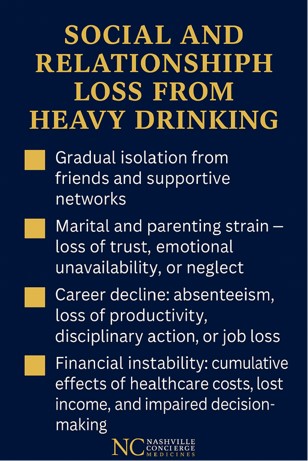
Clearly, Dave noticed the uptick in bottles that he carted out for recycling every week. He mentioned it a few times, but he didn’t seem too worried at first. Samantha took this as a sort of permission to keep doing what she was doing. Eventually though, she sensed the judgment rolling off him with his deep sighs and eye rolls, his tired look when she opened a new bottle. She noticed that he began drinking less while she was drinking more. “One of us has to stay sober with a baby in the house,” he would say. The accusation felt like a knife being driven home, but it wasn’t enough to make her stop. Instead, the guilt and the drinking felt like an endless self-reinforcing loop.
As another year went by, Dave began talking about having a second child. Samantha had always wanted more than one, and yet she couldn’t face the idea of doubling her workload. And, as hard as it was to admit to herself, she couldn’t face that long year without alcohol. Even if she opted out of breastfeeding, it was still nine seemingly interminable months, with no hope of comfort in a wineglass. Dave balked at her hesitancy, and grew angry and distant the more she pushed back on the idea of having another baby.
Physical Aging and Illness
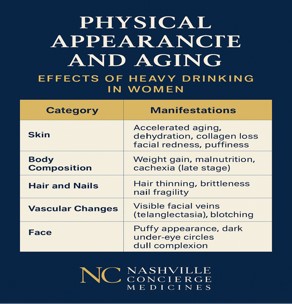
It didn’t help Samantha’s self-esteem that she was starting to look older than she actually was. She certainly felt older. Losing the “baby weight” hadn’t happened. No wonder, she told herself, since she was consuming 600 calories or more per day just in wine. She was probably missing some meals and replacing them with a drink, but she was so fatigued there was no way to fit in more than the occasional walk around the block with the baby in the stroller.
She began to have digestive trouble- occasional nausea and diarrhea- for no apparent reason other than, presumably, drinking too much. The headaches could last for days. Her hands shook in the mornings, and she felt her memory lapsing regularly. It started to occur to her that she might be doing permanent damage not just to her relationship, but to her body as well. Her mother had dealt with breast cancer not once but twice, and Samantha knew that heavy drinking increased her breast cancer risk.
Drinking stopped being quite so much fun. It was no longer a comfortable evening ritual to be enjoyed with pasta and a movie or with Dave after a long day. It was now a source of guilt and fear, and for a while that just made everything worse.
Emotional and Existential Losses
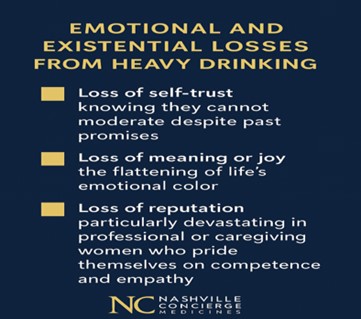
Samantha’s depression was pretty textbook. She stopped finding enjoyment in things. She stopped meeting up with friends: having a drink usually turned into three or four and she just couldn’t trust herself not to make a fool of herself in public. She slept poorly- it was always either not enough or way too much. She stopped listening to her body, and her weight climbed steadily as she began mistaking cravings for hunger and hunger for cravings.
Over the course of just a handful of years, drinking had narrowed her world to the confines of her house and a couple of disinterested friendships. Dave’s emotional distance branched into physical distance, as he spent more and more time at work.
Mortality Risks from Drinking
Samantha’s wake-up call was a gift. It was merciful. It was so much less traumatic than it might have been, and for that Samantha will be forever grateful. She managed to find sobriety without the trauma of a car accident or a cancer diagnosis, without the expense of accidental fire or her own near-death disaster.
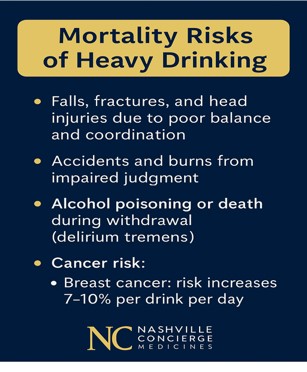
All it took for Samantha was a fall down the stairs in her own home. She had had her usual midday two glasses of wine and didn’t even register that she was dizzy. She was heading downstairs to take meat from the freezer to defrost for dinner and had paused at the top of the stairs, thinking she might pick up the baby- now almost two years old- and carry her down the stairs with her. But she decided to leave her in her crib for another few minutes and so it was that she did not have the baby in her arms when she missed a step and fell down the last eight stairs. She landed heavily on her wrist and tailbone, but she knew immediately- even as intense pain flared up- that it could have been so, so much worse. If she had been carrying the baby, she might have fallen forward instead, might well have hurt the baby. It was a moment of startling clarity that started Samantha down the road to recovery.
Life Expectancy Losses
Samantha recognized the near-miss as the gift that it was. She called Dave, who rushed home to drive her to the ER. She immediately asked for a psych consultation when she arrived at the hospital. She was admitted for observation to keep her safe during withdrawal from alcohol. Days later, she checked herself into a rehabilitation clinic.
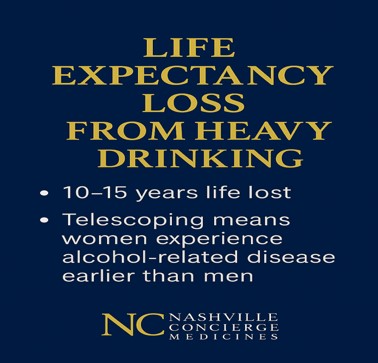
She learned there that women often have a different “drinking trajectory” than men. Men might have their first experience with alcohol at an earlier age, but women tend to be more likely to go from casual drinkers to heavy drinkers in a much shorter span of time. She also learned that heavy drinkers lose 10 to 15 years of life expectancy. All that life un-lived! What a waste! She knew that falls were common when people were drunk, but she didn’t know that 60% of fatal falls involved alcohol, or similarly, that a full third of fatal car accidents involved alcohol. The more she learned, the more thankful she was, and the more she wanted to be free of the chains of alcohol.
Her world grew slowly brighter. Her world grew larger. She was able to face the world, daughter’s hand in her own, without a glass in the other hand. Eventually, after their own work with a therapist, it was Dave’s hand there instead.
Conclusion
If what you’ve read here resonates with you- if you’re ready for care that feels personal, private, and encouraging- I, Dr. Conway, would be honored to be your physician. Our clinic in Nashville offers addiction services, including Suboxone therapy in Nashville.
At Nashville Concierge Medicines, every visit is unhurried and every patient is remembered. I listen carefully and respond thoughtfully. I stay available between visits, whether in the office or by secure telemedicine.
The bottom line is that you deserve care that is intelligent, kind, and consistent. Let’s get started!
Every woman has a story — and every story deserves excellent care.
If you want a physician who listens deeply and respects your identity,
➡️ reach out and let’s begin.
Start Suboxone Primary Care™ Today
Call for an appointment with Dr. Conway at Nashville Concierge Medicines.
👉 Call 615-708-0390 | Office & Telemedicine Appointments in our Nashville Clinic.
Telemedicine is available to Tennessee residents when clinically appropriate.
Nashville Suboxone+PrimaryCare™ Blog Series