Where Care Becomes Quiet Understanding
I am William Conway, a concierge physician in Nashville. To us, “concierge” means that I know you, I’m available to you, and I keep your story private and safe. When you speak, I hear what you say and what you do not say. I understand both the conscious and the unconscious, the quiet meaning that is the essence of you. Understanding this quiet essence allows us to share space which is meaningful to us both. Our professional relationship means that I am your doctor, with all that entails.
Our relationship will be both professional and spiritual. I’m a person, not a system, and so are you. My promise, as a physician committed to helping people, is to be your point person each and every time we meet. When you make an appointment with me in my clinic, I will be the person to shake your hand and look you in the eye, and together we will make decisions that will help you in your journey towards health.
In my practices- Nashville Suboxone+Primary Care™ and Nashville Concierge Medicines- I study constantly so that your care is well-informed. And I write constantly, so that your care is understandable. In our shared space, we will meet together and discuss whatever matters most to you, and we will share your future with joy.
Case Study: Sally
Sally is a 25-year-old graduate student studying to obtain her master’s degree in English Literature at a major state university. In college, she was an excellent student with a deep appreciation of both American and English comparative literature. As she belonged to a sorority, Sally enjoyed the frequent weekend social events, all of which seemed to invariably center around alcohol. She acquired a taste for alcohol and- more and more- found herself drinking beyond just the weekends.
Her use of alcohol accelerated, and within a semester or two, she was having three or four drinks regularly. While at home over summer break, Sally felt anxious upon waking in the mornings and found that her hands would shake until she’d had a drink. Her mother, a registered nurse who worked on a mental health unit, brought Sally in to see me, Dr. Conway, at Nashville Concierge Medicines. We discussed alternatives and her mother decided to have Sally try Vivitrol.
As we discussed Sally’s preferences and viewpoints, it became clear that Sally didn’t want to participate in Alcoholics Anonymous. She wanted to stop drinking discreetly, on her own. But she had already tried that- several times over the past school year in fact- and always went back to drinking. She had never been arrested or pulled over for drunk driving. However, her attendance at her graduate seminars had really dropped off, and the quality of her schoolwork was becoming erratic. Sally was losing her natural gift for writing. Her master’s thesis had to be delayed several times because of her frequent hangovers, which seemed to get worse all the time. Sally decided to take her mother’s advice and start taking the Vivitrol.
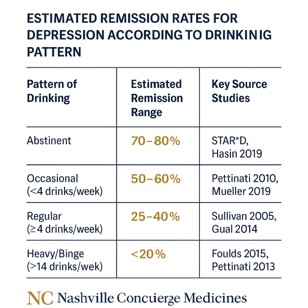
The Number of Drinks Per Week Predicts Risk of Disease from Alcohol
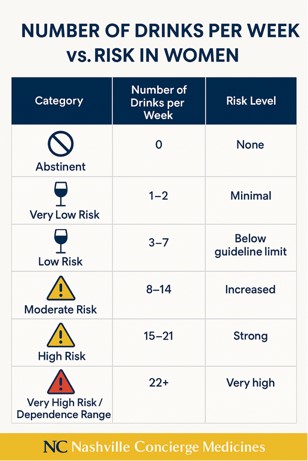
At first, the treatment worked. Sally stopped drinking for a while. She completed her master’s degree in English Literature and was able to get a job immediately after graduation. It was as a live-in nanny- an au pair- in a prominent home just outside of Paris, France! It felt like a chance to start fresh, in a new place, with a new job. Her charge was an adolescent girl named Marie. Marie’s father- a native Frenchman- had completed his MBA at a prestigious American university. He wanted his daughter to be internationally educated, and he hoped that she would obtain an undergraduate degree at an American university too.
Sally’s job was to provide an “immersion experience” for Marie, requiring Marie to always speak only English. Given Sally’s love of English Literature, this seemed like a perfect fit! And Sally loved the European lifestyle, the way mealtimes were luxuriated over, with languid conversations that allowed her to increase Marie’s understanding and vocabulary slowly but steadily. Sally also took naturally to the practice of enjoying a glass or two of wine at night. Sometimes she poured herself a third, but all was good. She even slept well. The wine seemed a more effective sedative than the Xanax that Sally had previously used.
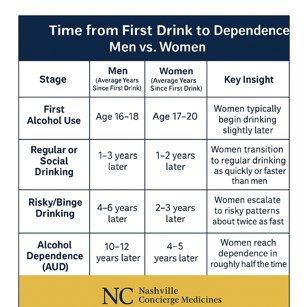
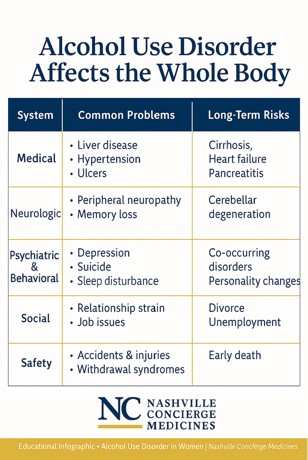
Women Progress to Serious Disease More Rapidly
While in France, Sally began to a date a foreign service officer, John, who worked at the American Embassy. John also liked his customary nighttime drinks. Sally and John dated casually, then more seriously, and then the relationship progressed to marriage. Sally continued to enjoy her three drinks every night. Her sleep was no longer restful. She woke in the mornings with shaking hands, and she learned that a glass or two of fine French wine calmed both her anxiety and her tremors.
But the biggest change of all was that, for the first time in her life, Sally began to experience sadness. Initially, these blues were mild, but they were noticeable.
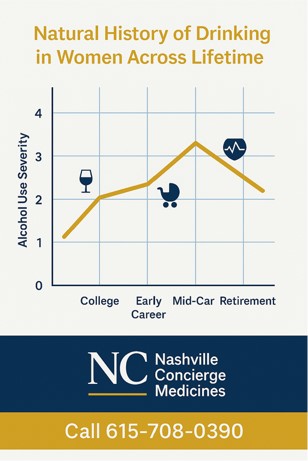
Drinking is Often Lifelong
John was transferred to Washington, D.C., to continue his work in the State Department. Together, they purchased a small home in Alexandria, Virginia. While John went to work, Sally, no longer employed, found herself drinking throughout the day.
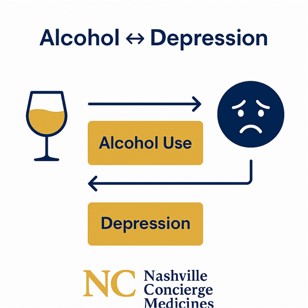
Sally Develops Depression
Five years later, still married but desperately lonely and bored, Sally’s depression had become chronic. She found herself feeling aimless, sad for days on end, with no interest in English Literature or much of anything else. She filled the days with wine and food and slowly gained 30 pounds. Fatigued, she could sleep 12 hours per day, but never feel truly rested. Feelings of worthlessness dominated her thoughts, and a doctor at a local mental health center prescribed her Prozac.
Sally’s Depression Does Not Respond to Psychiatric Treatment
Sally continues to drink throughout the day. Her Prozac doesn’t seem to help much at all. Over the next two years, Sally tries a variety of different antidepressants. Nothing works.
Sally finally allows herself to realize what she has known for a long time: Her drinking is the problem. Her drinking is altering her life. Her drinking is driving her life. She is already quite a ways down the wrong path and it’s going nowhere good. With John’s support, she checks in to a private rehabilitation center where she is able to stop drinking.
During her first days at the center, Sally experiences severe alcohol withdrawal symptoms, requiring a stay in the Intensive Care Unit to ensure she survives the delirium tremens. Slowly, she recovers and learns the coping skills she’s been missing. Sobriety clears her mind. Even her body feels more alive than it has in years. She stops feeding her body the junk she thought it was craving and stops feeding her mind the negativity she thought she deserved.
Back at home and six months gloriously sober, Sally is disappointed to find that she is still depressed. She continues to try different medications, as well as psychotherapy. She is eventually referred for transcranial magnetic stimulation, which is what finally helps her mood improve. The change is like moving from night to day! Her mood regulates, her appetite evens out, her cravings are diminished. She sleeps eight restful hours per night and feels good during the day. Her sexual relationship with her husband begins to improve, as does her sense of purpose in life.
Sally is fortunate to have received superior treatment for her alcohol use disorder, and her treatment-resistant depression. She knows that her life might have taken any number of horrible turns during her years of drinking. She might have failed at university, or lost her job as an au pair. Her marriage might not have survived the strains, and her sense of self might have been permanently bruised. There could have been chronic health problems or a car crash. For having found and accepted the support she needed, she feels a deep sense of gratitude.
Conclusion
If what you’ve read here resonates with you- if you’re ready for care that feels personal, private, and encouraging- I, Dr. Conway, would be honored to be your physician. We provide addiction care services here in Nashville, with a specialization on Suboxone treatment in Nashville. While suboxone is not for alcohol-related disorder, many patients have complex addiction issues. Please call for a private, respectful conversation about your issues.
At Nashville Concierge Medicines, every visit is unhurried, and every patient is remembered. I listen carefully and respond thoughtfully. I stay available between visits, whether in the office or by secure telemedicine.
The bottom line is that you deserve care that is intelligent, kind, and consistent. Let’s get started!
Every woman has a story — and every story deserves excellent care.
If you want a physician who listens deeply and respects your identity,
➡️ reach out and let’s begin.
Start Suboxone Primary Care™ Today
Call for an appointment with Dr. Conway at Nashville Concierge Medicines.
👉 Call 615-708-0390 | Office & Telemedicine Appointments in our Nashville Clinic.
Telemedicine is available to Tennessee residents when clinically appropriate.
Nashville Suboxone+PrimaryCare™ Blog Series