TMS in Depression
My name is William Conway, MD, and my patients simply call me Dr. Conway I am a general internist with a subspecialty in medicine addiction. I have practiced addiction medicine since 2012. Today, I combine that work through Suboxone+PrimaryCare™ in Nashville with the personalized attention of Nashville Concierge Medicine.
I care for people who want medicine to feel personal-where you are heard, remembered, and cherished. Our time together is your time alone to talk about your fears, your joys, your hopes. My role is to listen deeply and respond with both empathy and medical clarity, helping you take the actions that bring relief and restoration.
Depression is one of the most painful illnesses I see. It robs you of energy, joy and vitality. You stop laughing. You stop doing things that once brought comfort. You are sad, much, if not all of the time. You are robbed of energy. Your appetite is too much or doesn’t exist at all. You sleep too much or too little. A gray cloud has drifted across your soul, and refuses to move on.
Let me introduce an exciting treatment for those with the most severe depression, the depression which lasts for years, not responding well to medications. This is transcranial magnetic stimulation .
I do not provide Transcranial magnetic stimulation in my office. I, Dr. Conway, will refer you to a psychiatrist who provides transcranial magnetic stimulation (TMS).
TMS is an important treatment in psychiatry, which you must be aware of, because if offers hope to patients who have not responded to traditional treatments. In my concierge medicine practice, I am pleased to refer to psychiatrists who provide TMS
Meet Mandy
Mandy is a fifty-year-old woman, happily married, with one teenage daughter, Roberta. Roberta is the love of Mandy’s life. Roberta excels in cheer leading, with flexibility beyond belief. Mandy shares the experience of cheerleading with Roberta when she can and is able to.
Mandy is sad. Mandy is frequently very sad. Though Mandy does not admit it, Mandy often thinks that she would be better dead than alive. (Note: if you are having feelings of suicide, please call 988 immediately or check out Tennessee resources). In an occasional time of deep sadness, Mandy is preoccupied by thoughts of being a failure as a mother to Roberta. On some Friday nights before cheer, Mandy is so fatigued that she can barely get out of bed to watch Roberta cheering with the team. With extraordinary strength of willpower, Mandy overcomes her fatigue to be driven to the game by her devoted husband, John. The Friday night game is the rare time when Mandy is able to get out of bed or leave the couch.
Mandy was married to John when she was thirty-three. Before marriage, Mandy was a successful businesswoman in charge of the cosmetics department at a local Nordstrom. After the birth of Roberta, Mandy had the luxury of staying home to devote her full time to Roberta and John. The birth of Roberta was complicated, a prolonged postpartum depression, with suicidal ideation so strong that Mandy had a brief inpatient psychiatric hospitalization at their local University Hospital. Mandy was begun on Lexapro at that hospitalization.
After two months, her mood did lift, but it never returned to normal. Mandy the devoted mother found being a mother overwhelming. Roberta was high strung as an infant, requiring frequent cuddling during the night to sleep. Mandy was always tired during Roberta’s first five years of life.
The Lexapro slightly elevated Mandy’s mood, but she found that she no longer had a libido. Her sexual attraction to John disappeared. Mandy also gained 45 lbs over the next five years from Lexapro. Mandy was better, her mood less sad, but still sad, with 45 additional lbs
Mandy had excellent ongoing medical care from her psychiatrist over the next 15 years. During this period, Mandy had many different trials of many different medicines. She would never fully improve. Mandy received psychotherapy from her psychiatrist. Mandy never became healthy. Mandy was always impaired by sadness. Mandy was labeled as treatment resistant depression. Her psychiatrist elected to give Mandy transcranial magnetic stimulation.
What is Transcranial Magnetic Stimulation Treatment (TMS) in Nashville
Transcranial magnetic stimulation (TMS) is a treatment designed for Mandy.
Transcranial magnetic stimulation Treatment (TMS) is a very effective treatment in psychiatry for treatment resistant depression. It is also used in smoking cessation for nicotine use disorder, another serious brain disease that causes untold suffering from medical complications.
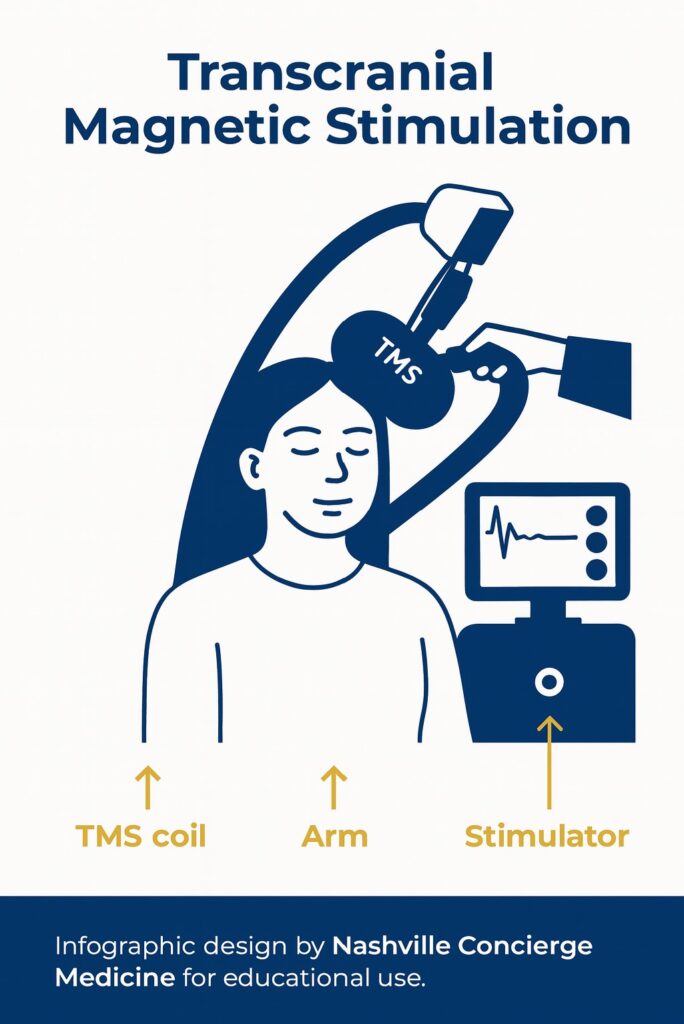
TMS does not require surgery. TMS does not require anesthesia. TMS does not invade the body.
The treatment is performed in the doctor’s office. The patient sits comfortably in a chair while a specialized coil is place near the scalp. The coil delivers gentle magnetic pulse that passes through the skull
Unlike medications, TMS does not circulate through the bloodstream. Hence, patients do not experience systemic side effects like weight gain, fatigue, or loss of libido, impairing sexual responsiveness.
Unlike electroconvulsive therapy (ECT), TMS does not require anesthesia, and does not induce a seizure. You can drive yourself home.
What is the benefit of transcranial Magnetic Stimulation (TMS) in Nashville
Mandy’s depression is not rare. In fact, Mandy’s disease is the most common, serious incapacitating disease in the world. You know family and friends who suffer from depression. You may suffer from depression. Together, for a moment, permit me to talk “Doctor talk.” Permit me to give you what the doctors call informed consent. Informed consent means I, Dr.Conway, explain to you, like I explained to Mandy, what you have, what your choices are, and what the risks for you are. I will begin.
Major depression is one of the most common, most serious, most incapacitating diseases in the world. The standard treatments is antidepressant medications and psychotherapy. These often provide relief, but many patients do not return to normal after multiple trials of different medications. We label these patients as treatment resistant. Thes patients are left with persistent sadness, loss of energy, poor concentration and impaired ability to work or maintain relationships. In my concierge medicine practice, I , Dr. Conway, often see patients with treatment resistant depression. You see that I have described Mandy
Transcranial magnetic stimulation treatment ( TMS) in Nashville is used for a common serious disease, depression which has not responded to treatment, leaving the patient with significant suffering. With this context, transcranial magnetic stimulation produces truly remarkable results
with over half of the patients getting better (response)
with 25 percent of the patients experiencing a return normal mood (remission).
The results of transcranial magnetic stimulation (TMS) in comparison to electroconvulsive treatment versus standard medical management is shown below. For patients who have spent years suffering despite multiple medications, these numbers represent life changing relief.
Many received TMS. Mandy initially got better. In fact, Mandy got so much better that she felt normal, despite her disease. Her disease remained, but the return to normal with treatment is what the doctors call remission.
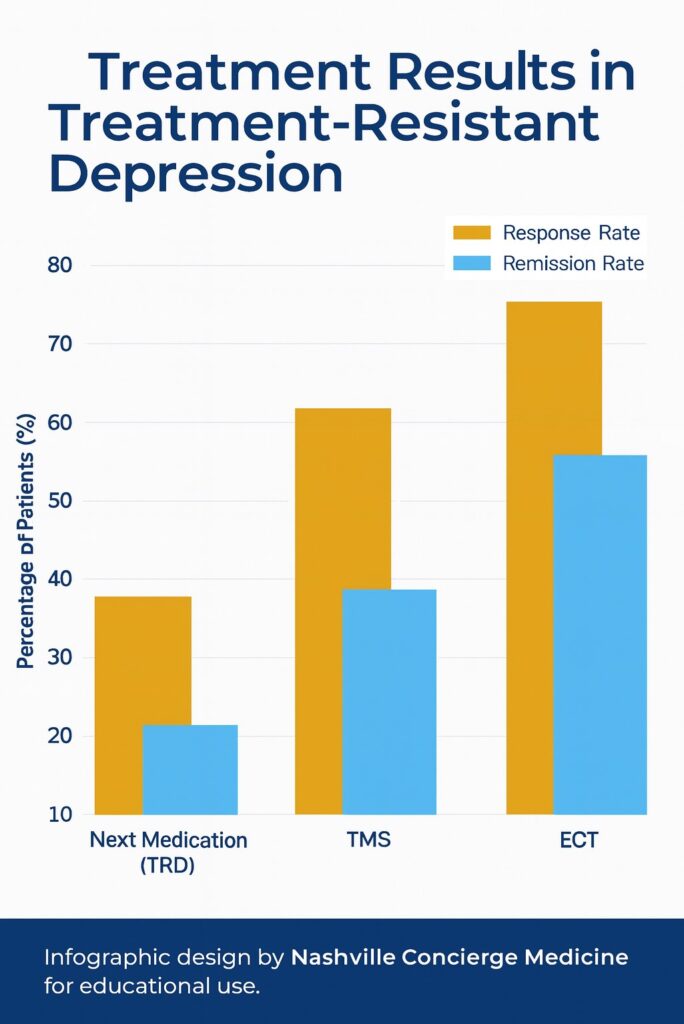
Comparison with ECT with TMS Treatment
Electroconvulsive therapy (ECT) has been available for decades in Nashville. It is highly effective for treatment resistant depression. ECT is an in hospital procedure, requiring general anesthesia and induction of a controlled seizure. While ECT may work faster than TMS, and has higher remission rates in some studies, it has more potential side effects such as memory loss or confusion.
In contrast, TMS treatment is performed as an outpatient, does not require sedation, and is associated with only mild temporary side effects such as scalp discomfort or headache. TMS has many benefits with minimal side effects.
What is the cost of transcranial Magnetic Stimulation (TMS) in Nashville
This is simply a hypothetical example. Different patients require different numbers of treatments for clinical benefit. Fifty sessions may be required for some patients. Market price of a session vary. The estimated cost for one treatment episode is approximately $12,500 to $25,000. Please note that multiple factors will affect this cash price including geography.
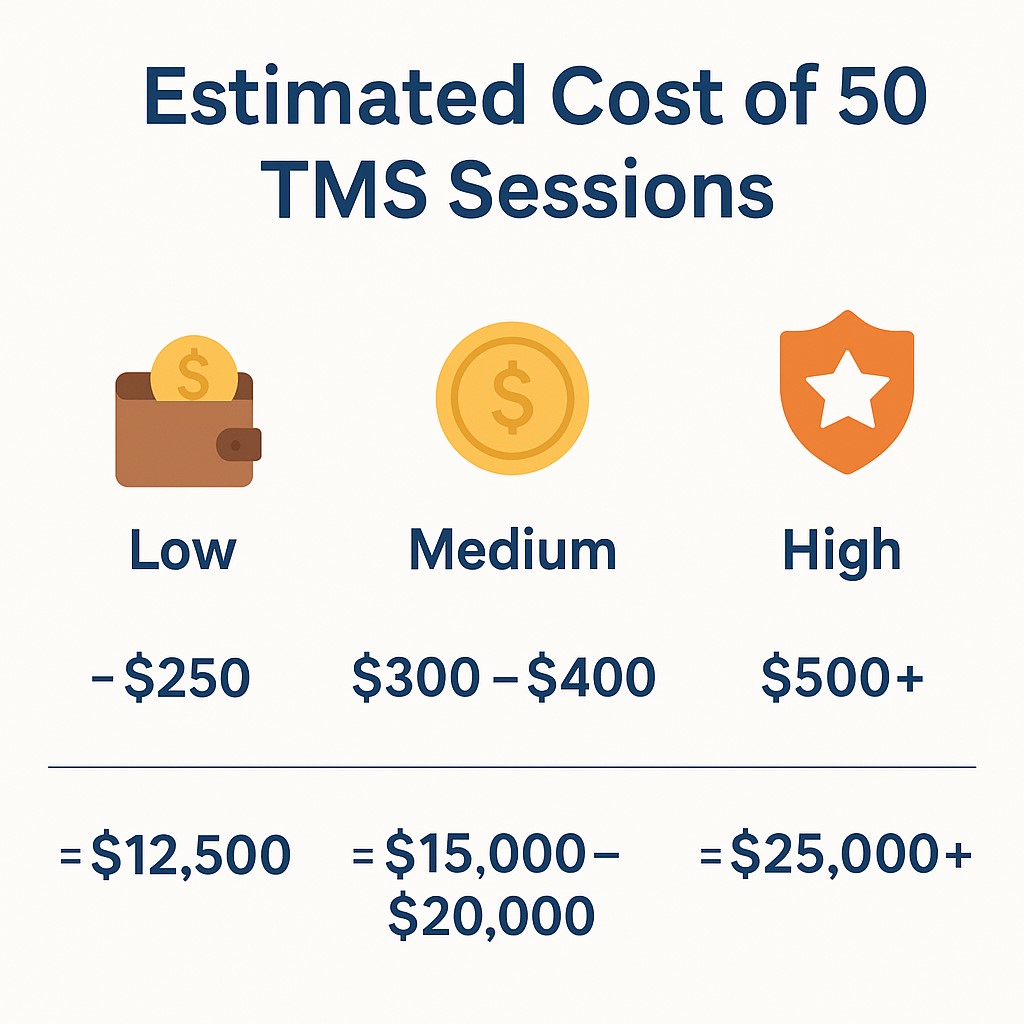
Your cost will depend upon whether your insurance covers TMS, the number of sessions, and the clinic location. The number of sessions is individualized. The duration of treatment also is individualized, with some programs delivering intense treatment multiple time per day to treatment spread out over weeks.
How does the Cost of Transcranial Magnetic Stimulation Treatment ( TMS) to compare to other common medical procedures?
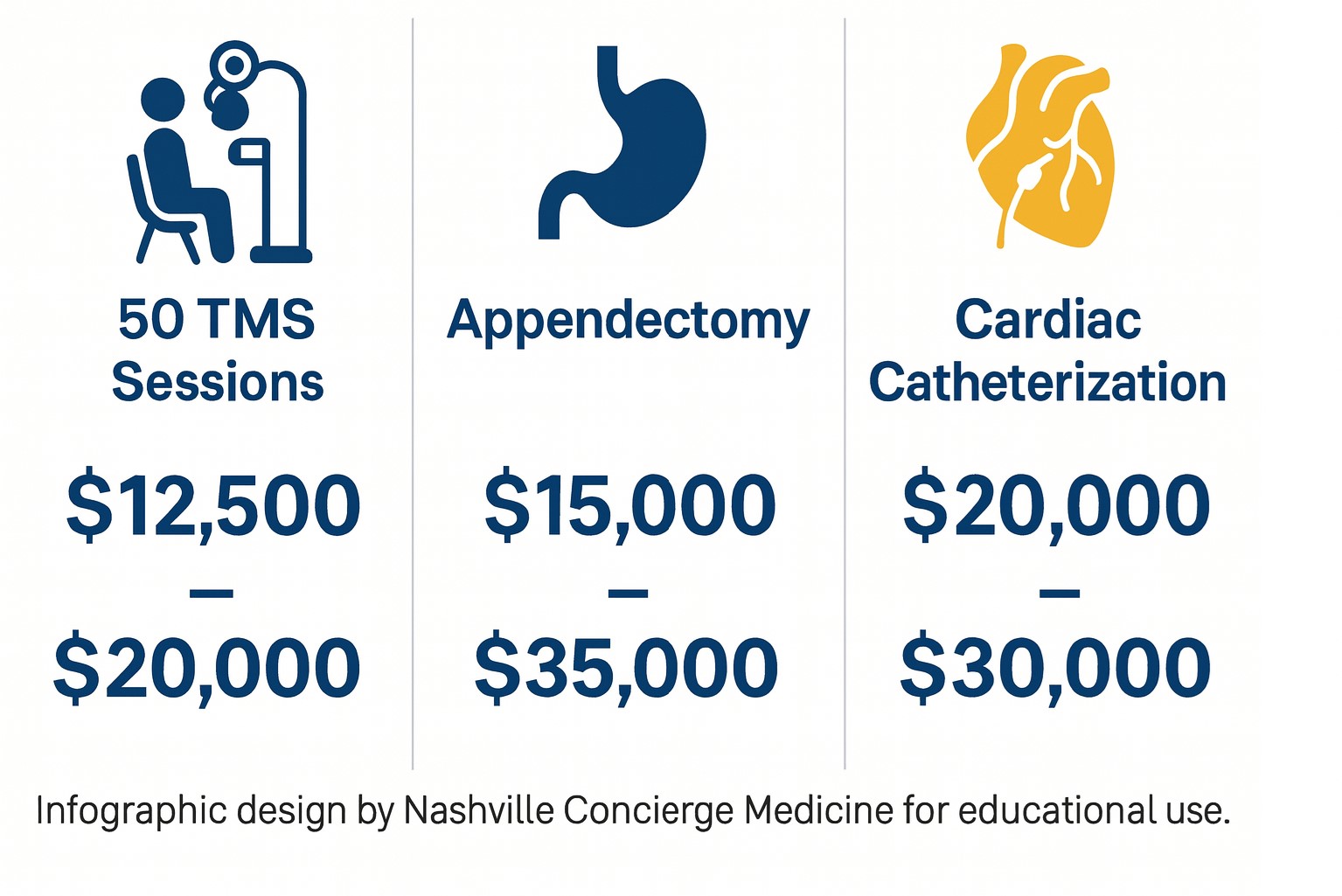
Transcranial magnetic stimulation has a price which is very similar to an appendectomy, a very common surgical procedure, or a single cardiac catheterization. For the benefit it produces for a incapacitating disease, transcranial magnetic stimulation is fairly priced. In my concierge medicine practice, I am always aware of the benefit and price.
Conclusion
Transcranial magnetic stimulation Treatment ( TMS) is an important advance to relieve suffering in patients with treatment resistant depression. It is safe, non-invasive, and effective. This is a treatment which offers a life-changing possibility for patients in Nashville. I am pleased in my concierge medicine practice to refer you to a psychiatrist who does TMS. In our suboxone+primary care ™ I, Dr Conway, look forward to treating your nicotine dependence with tobacco. Research is ongoing into TMS for nicotine use disorder: at this time, its only FDA approved use is treatment resistant depression.
CTA: Start Suboxone Primary Care™ Today in Nashville
👉 Call 615-708-0390 | Office & Telemedicine Appointments in our Clinic